q-value 基于p-value分布的FDR计量方法。
q-value可以简单理解为表示p-value产生假阳性的概率,当q-value < 0.05时,p-value显著的假阳性小于0.05。
可定义为:多重假设检验过程中,错误拒绝(拒绝真的原假设(零假设))的个数占所有拒绝的原假设个数的比例的期望值(也是代表出错率)
- pvalue:统计学显著水平,一般情况下, P-value < 0.05 该功能为富集项
- p.adjust 矫正后的P-Value
- qvalue:对p值进行统计学检验. 在100次检验中,如果发生100个差异基因,q设为0.05的话,就是100个检验用 5个犯错
Q-value is different and cannot be calculated by p.adjust. The idea is that when you have many p-values to adjust, they form a distribution. If all p-values come from the null hypothesis, the p-value distribution is going to be uniform on [0, 1]. But usually, our p-values are a mixture of the null distribution and alternative distribution. The parameter? describes the proportion of p-values (or tests) that comes from the null hypothesis.
Note that if you set , which means that you believe all the p-values come from the null distribution, then q-value is equal to FDR.
qvalue <= 0.05产生160个表达量具有显著差异的基因,这意味着有大约8个(160X0.05)被称作具有显著差异的基因是假阳的 也就是实际是0模型的。
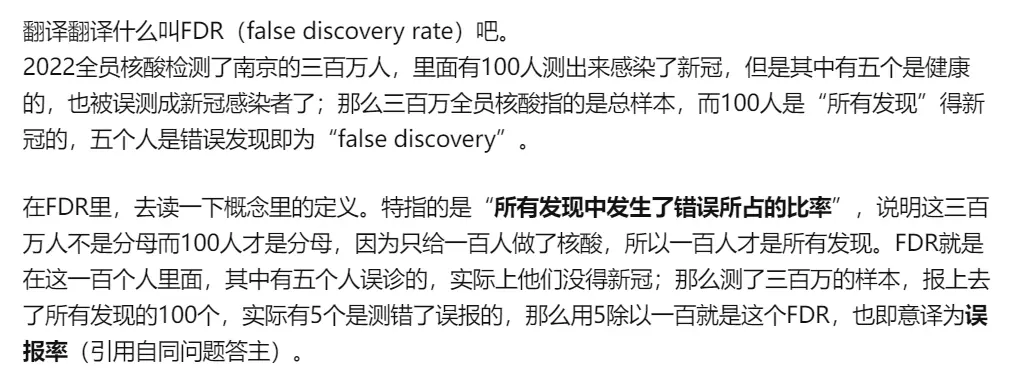
False discovery rate (FDR),误报率:“所有发现中发生了错误所占的比率”,也就是在计算所有的discovery中false(假发现)所占的比率。